On this page
- Step 1: Confirm PA DEP certification first
- Step 2: Get written quotes from at least two companies
- Step 3: Ask how they will hit the target
- Step 4: Get the guarantee and warranty in writing
- Step 5: Look at the paperwork you will get
- How this applies in York
- Key takeaways
- Frequently Asked Questions
- Talk to a certified York installer
To choose a radon mitigation contractor in Pennsylvania, start by confirming the person holds a current PA DEP mitigation certification, which state law requires. Then get at least two written quotes, ask how they will reach a result below 4.0 pCi/L, and get the clearance test, warranty and radon mitigation guarantee terms in writing before you sign.
Step 1: Confirm PA DEP certification first
In Pennsylvania, certification is not optional. The Radon Certification Act and 25 Pa. Code Chapter 240 require anyone who tests, mitigates or analyzes radon for someone else to be certified by the PA Department of Environmental Protection. Only owners testing their own homes and a few other narrow groups are exempt.
That makes this your first filter. A handyman, a general contractor or a home inspector without a DEP mitigation certification should not be installing your system.
To earn mitigation certification, a person must complete a DEP-approved radon mitigation course, pass a DEP-approved written exam and show relevant work experience. Certification lasts two years and must be renewed.
How to verify a contractor's certification
- Ask for the DEP certification number. It should be printed on the quote.
- Go to the PA DEP Radon Division page and open the radon services directory.
- Search by name or number. The directory is organized by county, so you can also see who is certified to work in York County.
- Make sure the name on the directory matches the person or firm doing your work, and that the certification is for mitigation, not only testing.
You can also call the PA DEP radon hotline at 800-237-2366 with questions.
Red flags to watch for
- No certification number on the quote or the business card
- A number that belongs to a different person or company
- A "certified" claim that turns out to be a national credential only
- Pressure to sign the same day, or a price that changes once the crew arrives
- No plan for a clearance test after the install
Some contractors list a national NRPP credential. That shows training, but it does not replace state certification here. We explain the difference in NRPP vs. PA DEP radon certification.
Step 2: Get written quotes from at least two companies
A real quote comes after someone looks at your house. Radon systems depend on the foundation, the soil under the slab, the sump pit and where the pipe can run. A phone price is only a guess.
When you compare quotes, check that each one lists:
- The number of suction points and where they go
- Whether the pipe runs inside or outside the house
- The fan make and model
- What will be sealed (floor-wall joint, cracks, sump pit)
- The gauge or alarm that shows the fan is working
- The clearance test and who does it
- Warranty and guarantee terms
Pennsylvania cost guides commonly cite roughly $800 to $2,500 for a standard system. Older stone and block foundations, crawl spaces and homes that need two suction points often cost more. If one quote is far lower than the others, ask what is missing.
Step 3: Ask how they will hit the target
Any contractor can install a fan. A good one can explain how the system will get your level below 4.0 pCi/L and keep it there. Ask these questions:
- Will you do a diagnostic check? Many installers test how well air moves under the slab before choosing the fan and the number of suction points.
- Where will the fan go? In Pennsylvania, the fan cannot go in a basement, crawl space or living space. It belongs in the attic or outside.
- Where will the exhaust end? State rules require it to point straight up and end at least 10 feet above the ground and 10 feet from operable windows and doors.
- What happens if the first test is high? Get the answer in writing.
Step 4: Get the guarantee and warranty in writing
There are usually two different promises on a radon job:
| Promise | Who gives it | What it covers |
|---|---|---|
| Fan warranty | The fan maker | The fan itself, for a set number of years |
| Workmanship warranty | The installer | Leaks, loose pipes, sealing and labor |
| Performance or clearance guarantee | The installer | Getting the clearance test below a set level |
A clearance guarantee matters most, because it protects the result you are paying for. Ask for a specific number (below 4.0 pCi/L), a clear statement that extra work is free, and a retest after any fix.
Step 5: Look at the paperwork you will get
When the job is done, you should get:
- The clearance test result
- A description of the system and how it works
- The fan maker's instructions and warranty
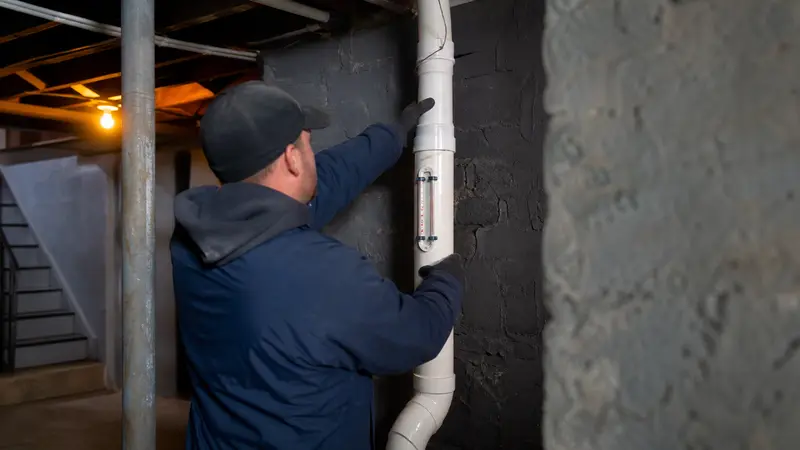
- A permanent system label with the installer's name, DEP certification number, contact details and install date
Pennsylvania's standards require the system label and recommend that you retest at least every two years. If you sell the house later, a buyer's agent will ask for this paperwork.
How this applies in York
York County is in EPA Radon Zone 1, and many homes here have stone, block or mixed foundations. Those homes are harder to fix than a newer poured slab. A contractor who knows older York housing will often find more entry points to seal, plan for a second suction point, and set a fair quote up front.
If you are under contract on a home, add one more question: can they fit the install and the clearance test before your closing date? Most single-family installs take a day, and the clearance test adds a few more.
Key takeaways
- Pennsylvania law requires PA DEP certification to mitigate radon for others. Check the number in the DEP directory.
- A national NRPP credential alone is not enough to work in Pennsylvania.
- Get at least two written quotes based on an on-site look.
- Ask where the fan and exhaust will go, and confirm they follow state rules.
- Get the clearance guarantee, warranties and test plan in writing.
Frequently Asked Questions
Can a home inspector install a radon system?
Only if that person also holds a PA DEP mitigation certification. A testing certification alone does not allow someone to install systems for others.
Is the cheapest quote a bad sign?
Not always. But a low price can mean fewer suction points, less sealing, no clearance test or no guarantee. Compare line by line.
Should I hire the same company to test and fix?
PA DEP says the installer should do a follow-up test after the system goes in. Many buyers and sellers also choose an independent DEP-certified tester for extra confidence.
Talk to a certified York installer
If you want a contractor who checks every box on this list, we offer radon mitigation in York, PA with DEP-Certified Installers, a free written quote and a guarantee in writing. You can read the full terms of our York radon clearance guarantee, or call (717) 356-3035 any time for a same-day callback.