On this page
Both a home test kit and a professional radon test can give a valid result if you follow the directions. A home kit is a cheap way to screen your own house. A professional test adds a calibrated continuous monitor, hourly data, tamper detection and a report from a DEP-certified tester, which most Pennsylvania home sales require.
How a home radon test kit works
Most store kits are passive devices. The most common type is a small charcoal canister or pouch that absorbs radon from the air over a few days. You open it, set it in the right spot, close it up at the end and mail it to a lab. The lab measures what the charcoal collected and sends you one average number in picocuries per liter (pCi/L).
Long-term kits work a little differently. An alpha track detector sits in your home for more than 90 days, then goes to a lab. It gives you a better picture of your average year-round exposure.
PA DEP notes that home test kits are sold at hardware stores, usually for about $20 to $30. Many come with the lab fee and return postage included. Check the box before you buy.
Where home kits fall short
A home kit only tells you what the air averaged over the test period. It cannot show you:
- Whether a window was opened halfway through
- Whether the kit was moved or bumped
- Whether a storm caused a short spike
- What happened hour by hour
Results also depend on you. Common mistakes include placing the kit too low or near a sump pit, leaving windows open, forgetting to write down start and stop times, or mailing the kit late. Late kits can be rejected by the lab, or give a less reliable number.
How a professional radon test works
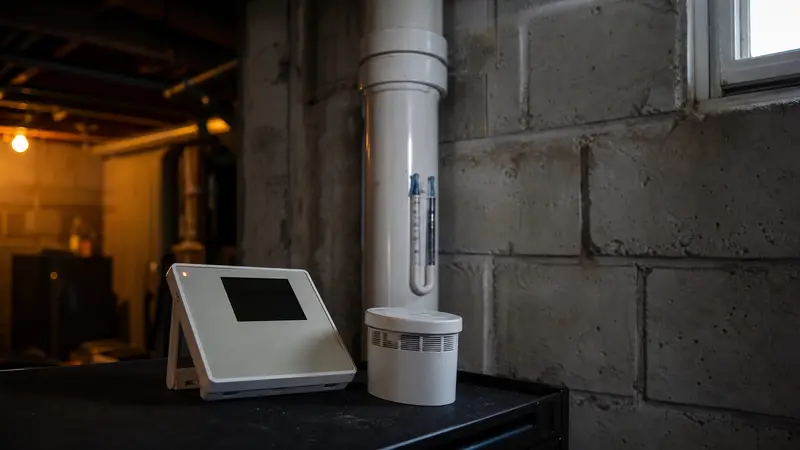
A professional test usually uses a continuous radon monitor (CRM). This is an electronic device that measures radon and records a reading every hour. Our tester places it, logs the start time and conditions, and picks it up after at least 48 hours.
A professional CRM gives you:
- Hourly data. You can see the pattern, not just one number. A steady reading looks different from a spike caused by an open door.
- Tamper detection. Many CRMs log motion, and some also log temperature, humidity and air pressure. That makes it harder for anyone to skew a result during a home sale.
- Calibration. Professional monitors must be calibrated on a regular schedule under national quality standards, so the device stays accurate over time.
- A certified report. You get a written report from a tester certified by the Pennsylvania Department of Environmental Protection (DEP).
Pennsylvania's certification rule
In Pennsylvania, anyone who tests for radon in someone else's home must be certified by PA DEP. This comes from the Radon Certification Act and 25 Pa. Code Chapter 240. That rule covers home inspectors, radon companies and anyone else who tests a home for a client.
You can test your own home with a kit. But if a buyer, seller or agent needs a result they can rely on, it should come from a DEP-certified tester.
Side-by-side comparison
| Factor | Home test kit | Professional test |
|---|---|---|
| Typical cost | About $10 to $40 (national cost guides) | Higher; varies by company |
| Device | Charcoal or alpha track | Calibrated continuous monitor |
| Data | One average number | Hourly readings plus average |
| Tamper detection | None | Motion and condition logging |
| Who sets it up | You | A DEP-certified tester |
| Speed of results | Test time plus mailing and lab time | Usually right after pickup |
| Accepted in home sales | Rarely | Yes, the usual choice |
Timing is a bigger difference than many people expect. A kit's test period is only part of the wait, because shipping and lab work add days. Read more about how long a radon test takes from start to finish.
When a home kit makes sense
A home kit is a good choice when:
- You own the home and are not selling soon
- You want a first screening and have never tested
- You want to check a second level or a part of the house a past test did not cover
- Budget is tight and you want to know whether a bigger test is needed
If your kit result is 4.0 pCi/L or higher, the EPA recommends a follow-up test before you decide on a fix. That second test can be another kit, a long-term test or a professional test.
When you should hire a professional
A professional test is the better choice when:
- You are buying or selling a home. Purchase agreements in Pennsylvania commonly call for a certified radon test, and the other side will want hourly data.
- You need an answer fast. A CRM gives results as soon as the test ends, with no mailing.
- Your kit result was close to 4.0. A professional test with hourly data can help confirm a borderline number.
- You just installed a mitigation system. A post-mitigation test should be run no sooner than 24 hours after the system starts and within 30 days, per EPA guidance. A certified test documents that the system works.
- You want the setup done right. Placement and closed-house rules affect the result. A trained tester handles those for you.
Does a professional test give a "better" number?
Not always. A properly used home kit and a professional monitor in the same spot should give similar results. Both have a margin of error, and radon levels swing with weather and season. Two good tests can still differ.
The main advantage of a professional test is confidence in how the number was produced. You know where the device sat, when it ran and whether conditions held steady. For a home sale, that record often matters as much as the number itself.
Key takeaways
- Home kits and professional tests can both give valid results.
- Kits are cheap and good for screening your own home.
- Professional continuous monitors add hourly data, tamper detection and a certified report.
- Pennsylvania requires DEP certification for anyone testing radon in another person's home.
- Most home sales call for a professional test.
- A high kit result should be followed by a second test before you decide on mitigation.
Frequently Asked Questions
Can I use a home kit for a home sale in Pennsylvania?
A seller can share their own kit result, but most buyers and agents ask for a test by a DEP-certified tester. Buyers usually hire their own certified test during the inspection period.
Are charcoal kits accurate?
Yes, when you follow the directions, place them correctly and mail them on time. They give one average number and cannot show spikes or tampering.
Should I test again if my kit reads high?
Yes. The EPA recommends a follow-up test for any first short-term result at or above 4.0 pCi/L. Fix the home if the follow-up confirms a high level.
Get a certified radon test
If you need a result you can rely on for a sale or a big decision, book radon testing in York, PA with our certified tester. Call (717) 356-3035 any time for a same-day callback.