
On this page
Radon mitigation in a historic home can be done without harming its character. The key is planning the pipe route and fan location so they stay off the front of the house, and checking with your local review board before any exterior work. Interior routes, rear walls and attic fans keep most systems nearly invisible from the street.
Why historic homes need a little more planning
Radon mitigation in a historic home uses the same basic system as any house: a fan creates suction under the floor and vents soil gas above the roof. What changes is how carefully the visible parts are placed.
Historic homes raise three extra questions:
- Where can the pipe go without crossing the main facade or cutting into original trim?
- Do I need approval from a local historic review board?
- How do I handle an old foundation, like stone walls or dirt areas, without harming original materials?
Pipe routing options
Interior route with an attic fan
The pipe rises through the house, often in a closet, a back stair area, a pantry or an unused chase, and exits through the roof. The fan sits in the attic. From the street, you may see only a short pipe above the roof, which can often be placed on a rear slope.
Pros: Least visible outside. Cons: Uses interior space and may need work in finished rooms.
Rear or side exterior route
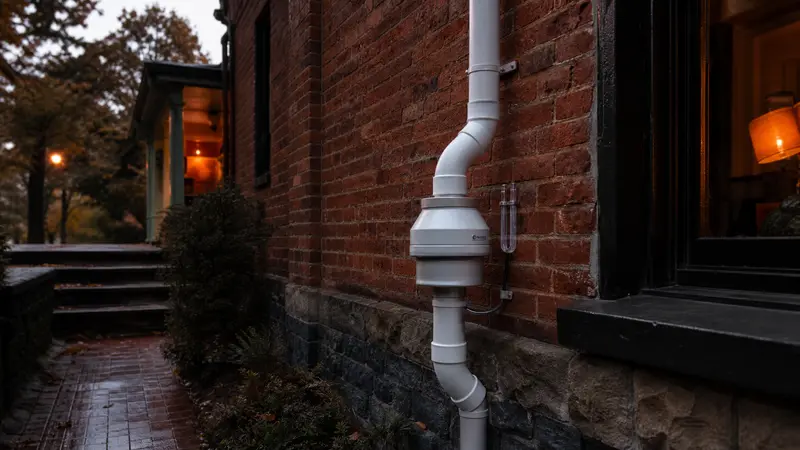
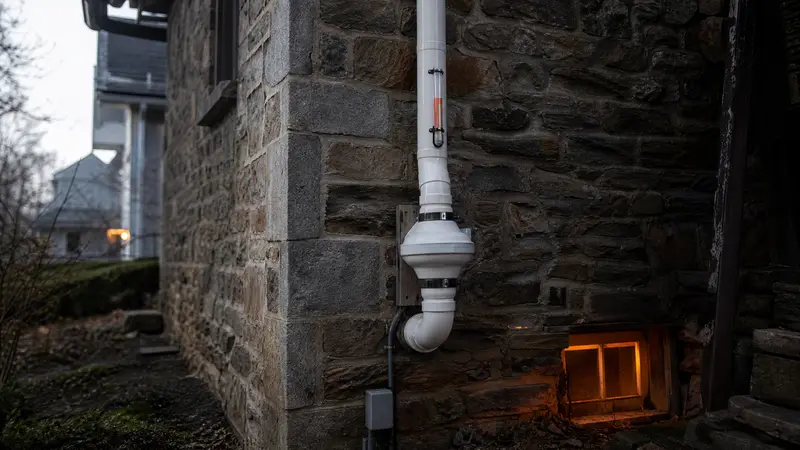
The pipe exits the basement on a rear or side wall, runs up the outside and discharges above the roof edge. The fan mounts outside.
Pros: No interior disruption, quieter inside. Cons: Visible from the yard or alley. On a corner lot, the side wall may face a street.
Ways to make exterior pipe blend in
- Paint the pipe to match the wall or trim.
- Run it along a corner or next to a downspout.
- Use an enclosure or chase box on the exterior.
- Keep it on a secondary elevation, not the front.
What about the chimney?
Many old homes have unused chimney flues, and it can be tempting to run the radon pipe up one. Radon standards do not allow soil gas to be vented into a chimney flue. The radon pipe needs its own sealed route.
Historic review in York City
York City has a Historical Architectural Review Board (HARB). Properties in the city's historic district go through a review and Certificate of Appropriateness process for certain exterior changes, such as work on windows, doors, roofs, siding and masonry. The city's application asks for photos of elevations visible from public ways, which shows that street visibility is a main concern.
Whether an exterior radon pipe needs review depends on the property and where the pipe goes. Inside the HARB district, the city says exterior work visible from a public street or alley needs approval before it starts, even when no permit is required. That can include the back of a house that faces an alley. Before you install, check with the City of York permits and zoning office. An interior route is often the simplest path, but get the answer for your property in writing.
If your home is outside the city, it may still be listed on a historic register. A register listing alone does not always bring local review rules, but ask your municipality.
Protecting original materials
Historic homes often have fieldstone foundations, original brick and old lime mortar. A careful installer:
- Drills through mortar joints instead of face brick or stone where possible.
- Uses mortar that is compatible with old, soft mortar for any repointing, since hard modern mortar can damage old brick.
- Keeps wall penetrations small and neatly sealed.
- Avoids cutting original trim, moldings and floors.
For the foundation itself, stone walls often need extra sealing or suction points. Our guide to radon mitigation for fieldstone foundations covers those options in detail.
Reversibility
Preservation guidance generally favors changes that can be undone later without harming original fabric. A radon system fits that idea well. Pipes, fans and suction points can be removed, and the small holes patched, if the system is ever no longer needed.
York's older and historic housing
York has a large number of older brick rowhomes and twins, many on fieldstone foundations, and some sit in the city's historic district. The county is in EPA Radon Zone 1, so a historic home here deserves a radon test as much as any other. In Pennsylvania, only a PA DEP certified mitigator can install a system for you. You can learn more on the PA DEP Radon Division site.
Key takeaways
- Historic homes can be mitigated without changing the street view.
- Interior routes with attic fans are the least visible option.
- Rear or side routes work well when painted and placed carefully.
- Radon pipes cannot be vented into a chimney flue.
- Check local historic review rules before any exterior work.
Frequently Asked Questions
Will a radon system hurt my home's historic value?
A well-placed system is small and reversible. Keeping it off the front elevation protects the look of the home.
Can the fan go in the basement?
No. Standards require the fan to be outside the living space, such as outdoors or in an attic, so any leak in the fan or pipe is not inside the home.
Do historic homes need different testing?
No. Testing works the same way. Test the lowest lived-in level under closed-house conditions.
Plan a system that fits your historic home
We plan each route around the house's look and the foundation underneath. See our approach to older-home radon mitigation in York, or call (717) 356-3035 any time for a same-day callback and a free written quote.