On this page
Radon is not overblown, but it is often oversold. The risk is real and well studied: EPA estimates about 21,000 U.S. lung cancer deaths a year from radon. It is also a long-term risk, not an emergency. The right response is calm: test, and fix high levels with a proven method. For local numbers, see our York County radon statistics.
Why some people think radon is hype
It's fair to be skeptical. A few things make radon sound like a scare:
- You can't see or feel it. A risk with no symptoms can seem made up.
- Sales pressure. Some marketing leans on fear to sell systems.
- Big round numbers. National death estimates can feel abstract.
- Early risk data came from miners. Critics point out that uranium miners breathed far higher levels than most homes have.
Those are reasonable questions. Here is what the evidence says.
What the research shows
Studies in homes, not just mines
The early evidence did come from underground miners. But researchers later studied people in ordinary homes. Large pooled studies in North America and Europe compared lung cancer patients with similar people who did not have lung cancer, and measured radon in their homes.
Those studies found that lung cancer risk rose with home radon levels, including at levels common in houses. A pooled analysis of 13 European studies (Darby et al., BMJ, 2005) found that risk rose by about 8% for every 100 Bq/m3 (about 2.7 pCi/L) of measured home radon. After correcting for measurement error, that rose to about 16%. A pooled analysis of 7 North American studies (Krewski et al., Epidemiology, 2005) found about an 11% increase in risk at 100 Bq/m3.
Agreement across major health bodies
- EPA estimates radon causes about 21,000 U.S. lung cancer deaths a year, about 2,900 of them among people who never smoked (EPA health risk of radon).
- CDC advises testing because most people don't have symptoms until lung cancer is advanced.
- The World Health Organization calls radon a leading cause of lung cancer after smoking.
- The International Agency for Research on Cancer classifies radon and its decay products in Group 1, "carcinogenic to humans."
When agencies in many countries reach the same conclusion from separate data, that's strong evidence.
The fair criticisms, answered
"The death estimates are uncertain." True. They are modeled estimates with a range, not a body count. But the uncertainty is about how many, not whether radon causes lung cancer.
"Most risk is among smokers." Also true. Smoking multiplies radon risk. But EPA still estimates thousands of deaths a year among people who never smoked.
"4 pCi/L is not the same as 40." Correct. Risk rises with the level. A result just over 4 is a reason to fix your home soon, not to panic. A result of 40 deserves faster action.
"Companies use fear to sell systems." Sometimes. That's a reason to work with a PA DEP-certified firm, get a written quote and insist on a clearance test. It isn't a reason to ignore the test result.
Where hype does creep in
Some claims go too far. Watch out for:
- Lists of "radon symptoms" like headaches or fatigue. Radon has no immediate symptoms.
- Claims that air purifiers, sealing alone or opening windows solve the problem. EPA does not support those as reliable fixes. For more, see do air purifiers remove radon.
- Pressure to sign the same day without a written quote.
- Promises of "zero radon." Outdoor air itself has some radon.
Calling out hype doesn't mean radon is fake. It means you deserve accurate information.
What the numbers look like locally
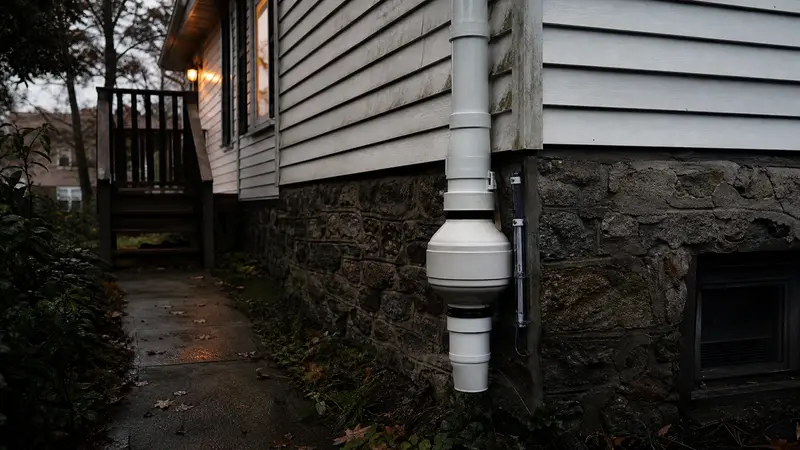
York County is in EPA Radon Zone 1. PA DEP's test data for the county shows about half of reported tests at or above 4.0 pCi/L.
Pennsylvania has history here, too. In December 1984, Stanley Watras, a worker at the Limerick nuclear plant, kept setting off the plant's radiation alarms. The source turned out to be radon in his Berks County home, on the Reading Prong. The case drew national attention and helped launch Pennsylvania's radon program. York County is not on the Reading Prong, but its own geology still produces many high results.
A balanced way to think about radon
- It's real. Decades of research link long-term radon exposure to lung cancer.
- It's not urgent in hours or days. Risk builds over years.
- It's measurable. A test gives you a number.
- It's fixable. EPA says most homes can be reduced to 2 pCi/L or below with a proper system.
That combination makes radon a good problem to deal with. You can find out cheaply and fix it reliably.
Key takeaways
- Radon risk is backed by studies of both miners and ordinary homes.
- EPA, CDC and WHO all treat radon as a leading cause of lung cancer.
- Death estimates are uncertain in size, not in direction.
- Hype exists, mostly around fake symptoms and weak fixes.
- Test, then fix high levels with a certified pro.
Frequently Asked Questions
Should I worry if my result is just over 4.0 pCi/L?
Not worry, but act. Plan to fix it, without rushing into a bad deal. Get a written quote from a certified mitigator.
Is radon more dangerous than other home hazards?
EPA ranks radon as the top cause of lung cancer among people who never smoked. It's one of the more serious long-term home hazards, and one of the easiest to fix.
Get the local facts
See the real numbers for your area on our York County radon levels page, built from PA DEP test data. Want a no-pressure answer about your home? Call (717) 356-3035 any time for a same-day callback.