
On this page
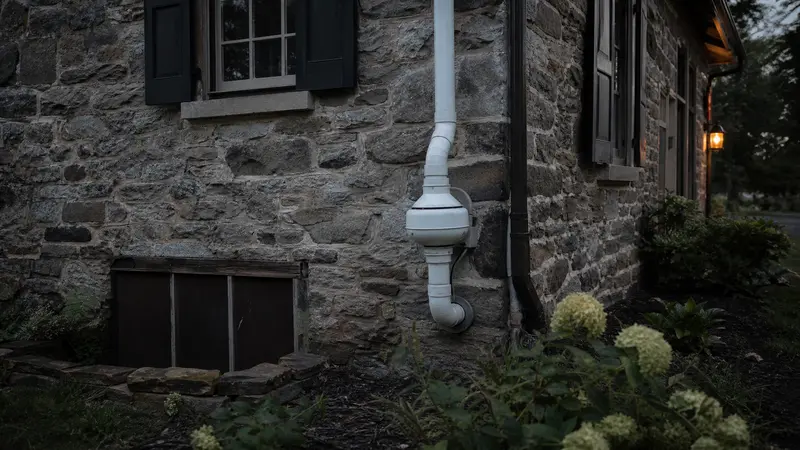
Radon mitigation cost in York is usually higher on a stone foundation because older homes need more suction points and much more sealing. Fieldstone walls have many open gaps, and old basement slabs are often thin, cracked or only partly poured. Our price for older-home systems is $1,200 to $2,200, set by a free written quote.
Why does radon mitigation cost more in older homes?
A radon mitigation system works by creating low pressure under the house so soil gas goes up a pipe instead of into your basement. That only works if the area under the slab is fairly well sealed and the fan can reach all of it. Newer poured basements make that easy. Older homes often do not.
Here are the main reasons older and stone-foundation homes cost more.
Fieldstone and rubble walls leak
Fieldstone and rubble walls are made of stacked stone held with mortar. Over a century, the mortar cracks and washes out, leaving gaps. Soil gas moves through those gaps easily. Before a fan can do its job, the worst openings need to be sealed, and some walls need a full parge coat or a sealed membrane. That is extra time and material.
Slabs may be thin, cracked or missing
Many old York basements started as dirt floors. Later owners poured a thin slab over part or all of the floor. That slab may have no gravel layer under it, which makes it harder for the fan to pull air across. Cracks and gaps along the walls let basement air leak in and weaken suction.
When the slab is thin or partial, we often need more suction points to cover the whole floor, or a different design such as a membrane over the unfinished areas.
More suction points
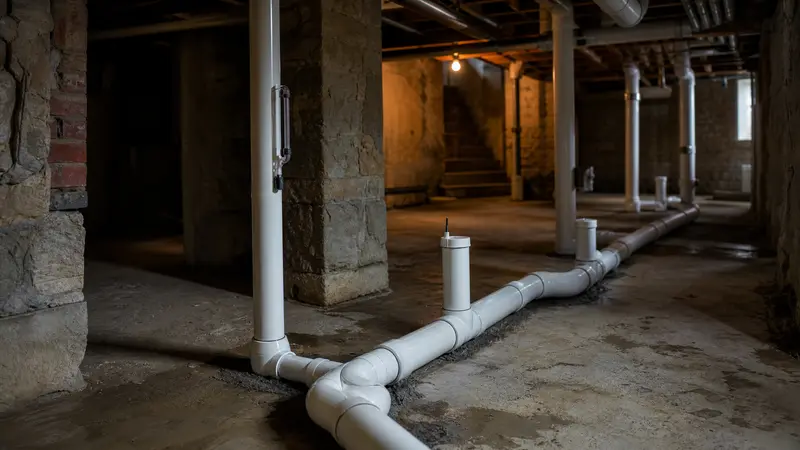
A modern poured basement often needs just one suction point. An older home may need two, three or more. Each point means coring the slab, digging a pit, more pipe and fittings, and sometimes a stronger fan to pull from several points at once.
Mixed foundations
Many older York homes have been added onto over the years. You might have a stone basement under the original house, a block foundation under an addition, and a crawl space under a back porch room. Each area may need its own approach. If part of your home sits over a dirt crawl space, see our guide on crawl space radon mitigation cost for how that adds to the job.
Harder pipe routes
Rowhomes and older houses often have tight lots, shared walls and finished attics. Running pipe from the basement to above the roofline can take more planning. Interior routes may need to pass through closets. Exterior routes may need to go up a tall wall.
Bigger or stronger fans
With leaky foundations and poor soil airflow, a standard fan may not create enough suction. A higher-suction or higher-airflow fan costs more to buy and to run.
What the extra work looks like
| Item | Modern poured basement | Older stone or rubble basement |
|---|---|---|
| Suction points | Usually 1 | Often 2 or more |
| Sealing | Main cracks, sump lid | Wall gaps, floor-wall joint, slab cracks, possible parge or membrane |
| Slab condition | Even, gravel underneath | Thin, cracked, partial or no gravel |
| Fan | Standard | Often higher suction |
| Our typical price | $935 to $1,320 | $1,200 to $2,200 |
National cost guides give a sense of how much work can add. HomeGuide lists block-wall depressurization at about $1,800 to $3,000, compared with about $1,200 to $2,000 for a typical active sub-slab system. Your house may fall in a very different range, so treat these numbers as context only.
Does the higher cost pay off?
Older homes can still get well below the EPA action level of 4.0 pCi/L. The extra work is what makes that possible. A cheap system that skips sealing on a stone foundation may run fine but fail the clearance test. That is why we put a written clearance guarantee on every job: if the post-install test is not below 4.0 pCi/L, we keep working at no charge.
York context
York County is in EPA Radon Zone 1, the highest radon potential category. The city and county have a large stock of pre-war houses, rowhomes and farmhouses, many with stone or rubble foundations. That is a big reason York quotes vary more than national averages suggest.
If your home is older, our page on older-home radon mitigation in York explains how we design systems for stone, rubble and mixed foundations.
How to keep costs in check
- Get a written quote after an on-site visit. A phone price cannot account for stone walls or partial slabs.
- Ask how many suction points are planned and why.
- Ask what sealing is included. In older homes, this is where quotes differ most.
- Plan around renovations. If you are finishing a basement, put the system in first.
- Ask about the clearance guarantee. Make sure it is in writing.
Key takeaways
- Stone, rubble and block foundations leak more soil gas, so they need more sealing.
- Older homes often need more than one suction point and a stronger fan.
- Mixed foundations and harder pipe routes add labor.
- Our price for older homes is $1,200 to $2,200, set by a written quote.
- A clearance guarantee protects you if the first design is not enough.
Frequently Asked Questions
Can a stone basement get below 4.0 pCi/L?
Yes, in most cases. It may take more suction points, more sealing or a stronger fan, but older homes can reach the EPA action level target.
Should I seal the walls myself before getting quotes?
It is better to wait. The installer needs to see the foundation as it is to design the system and plan the sealing.
Will a radon system damage an old foundation?
No. A properly installed system cores small holes through the slab and seals them around the pipe. It does not weaken the walls.