
On this page
- Where the rules come from
- 1. Inspect before you design
- 2. Where the exhaust must end
- 3. Where the fan can and cannot go
- 4. What must be sealed
- 5. Gauges and warning devices
- 6. Pipe, wiring and materials
- 7. The system label
- 8. What you must receive
- 9. Testing after the install
- How the national standards fit in
- How to use this as a homeowner
- Key takeaways
- Frequently Asked Questions
- Built to code in York
Pennsylvania radon mitigation standards are set in 25 Pa. Code 240.308 for homes three stories or less. They require the exhaust to vent straight up, at least 10 feet above ground and 10 feet from operable windows and doors, keep the fan out of basements and living space, require sealing and labels, and recommend retesting every two years. Our DEP-certified radon installers follow them on every job.
Where the rules come from
Pennsylvania's Radon Certification Act gives the PA Department of Environmental Protection authority over radon testing and mitigation done for others. The details live in 25 Pa. Code Chapter 240. The chapter covers who must be certified, how testing is done, reporting to DEP and how systems are installed.
Section 240.308 sets the mitigation standards for detached and attached homes three stories or less. That covers most York houses, rowhomes and twins. DEP also publishes a longer technical guidance document called the Pennsylvania Radon Mitigation Standards, which adds detail on materials, gauges and wiring. The current version, document 294-2309-002, took effect March 4, 2023.
1. Inspect before you design
The mitigator must do a visual inspection of the building before installing a system. That means looking at the foundation, slab, walls, sump, drains and possible pipe routes. It is the basis for a sound design and a fair written quote.
2. Where the exhaust must end
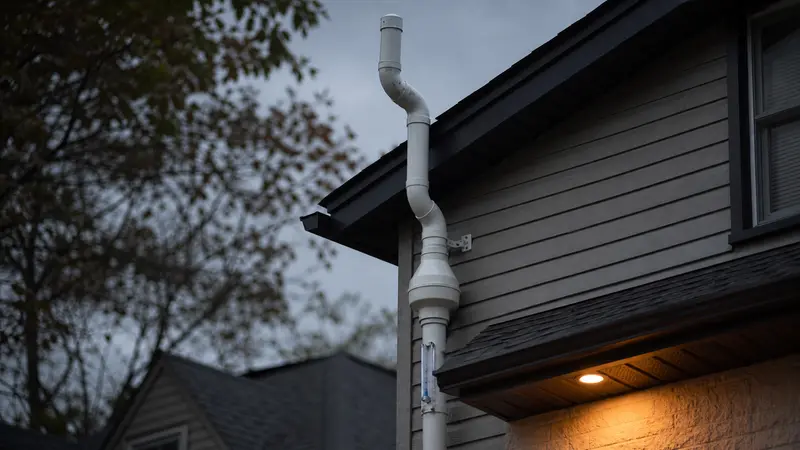
The exhaust (the termination point) is where the radon leaves your home. Under 240.308, it must:
- Point vertically upward, outside the building, discharging to open air
- End 10 feet or more above the ground level
- Be 10 feet or more from an operable window, door or other opening into living space
- Have no rain cap
DEP's technical guidance adds that roof penetrations should end at least 12 inches above the roof surface, and that an exhaust closer than 10 feet to an opening must be at least two feet above the top of it.
These rules keep the radon you just removed from blowing back into your home or a neighbor's window.
3. Where the fan can and cannot go
The fan may not be installed below grade, in a window well or egress well, or in the conditioned (heated or cooled) part of the house. DEP's guidance also rules out basements and crawl spaces under the living space.
So radon fans go in an attic, a garage attic, or on an outside wall. The pipe after the fan is under positive pressure, so a leak indoors would push radon into the home.
4. What must be sealed
Mitigators must seal openings that let soil gas in, using urethane caulk or an equal material. The standards name:
- Cracks where the slab meets the foundation wall (the floor-wall joint)
- Perimeter channel drains (French drains)
- Openings around utility pipes and lines
Sump pits that let soil gas in must be covered and sealed. DEP's guidance says the cover should have a radon-resistant drain if there is no other floor drain.
For crawl spaces and dirt floors, DEP's guidance calls for plastic sheeting of at least 6-mil polyethylene (or 3-mil cross-laminated), with seams overlapped at least 12 inches and sealed.
5. Gauges and warning devices
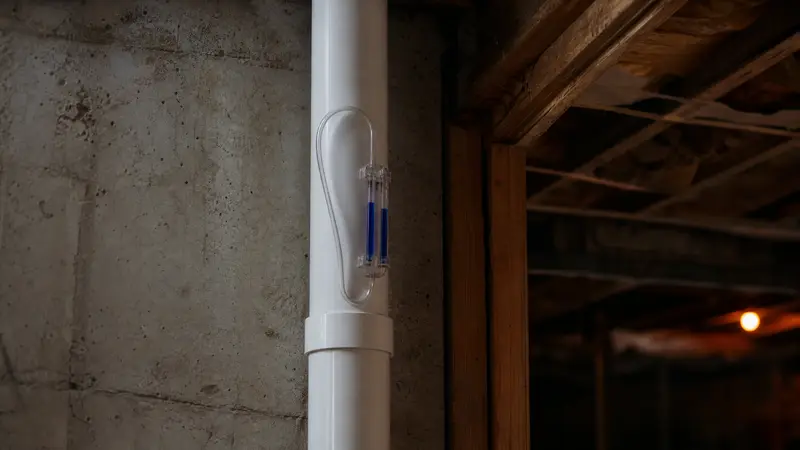
DEP's guidance requires every active system to have a way to monitor fan performance, such as a manometer (U-tube gauge), magnehelic gauge, airflow monitor or amperage meter. Electrical alarms must be on circuits that cannot be switched off, and must reset on their own after a power outage.
That gauge is how you know the fan is working. PA DEP advises homeowners to check it periodically.
6. Pipe, wiring and materials
DEP's guidance sets Schedule 20 PVC, ABS or equivalent as the minimum pipe, with Schedule 40 recommended in garages and spots where the pipe could be hit. Wiring must follow the National Electrical Code. Plug-in fan cords can be no more than six feet long and cannot run through or inside a wall. Visible interior pipe must carry at least one label per floor.
7. The system label
Every system must have a permanent, prominent label. Under 240.308, it must show:
- The certified installer's name
- Their DEP certification number
- Contact information
- The installation date
- The statement that the building should be tested for radon at least every two years
8. What you must receive
When the job is done, the mitigator must give you written information about the system. DEP's guidance lists a description of the system and how it works, the maker's instructions, how to read the gauge or alarm, and a recommendation to retest at least every two years.
9. Testing after the install
DEP's guidance calls for a short-term post-mitigation test no sooner than 24 hours and no later than 30 days after the system is finished and running. That matches EPA guidance. Certified people must also report their testing and mitigation work to DEP.
How the national standards fit in
The EPA now points to the ANSI/AARST soil gas mitigation standard for existing homes (SGM-SF) as the current national practice standard, and DEP's guidance references it. Pennsylvania's own rules still set the legal minimum here. A good installer meets both.
How to use this as a homeowner
Use the code as a quick check on any quote or finished system:
- Is the fan outside or in the attic, not in the basement?
- Does the exhaust point straight up, high enough and away from windows?
- Is the sump sealed, and are the floor-wall cracks caulked?
- Is there a gauge you can read, and a label with a DEP number?
If the answer to any of these is no, ask why. For more on vetting the company itself, read how to choose a radon contractor in PA.
Key takeaways
- 25 Pa. Code 240.308 sets Pennsylvania's mitigation rules for homes three stories or less.
- The exhaust must vent straight up, 10 feet above ground and 10 feet from operable windows and doors, with no rain cap.
- The fan cannot be below grade or in living space.
- Floor-wall joints, channel drains, utility openings and sump pits must be sealed.
- Every system needs a gauge, a permanent label with a DEP number, and a retest every two years.
Frequently Asked Questions
Do these rules apply to commercial buildings?
Section 240.308 covers homes three stories or less. Larger buildings follow other protocols, so ask your installer which standard they use.
Can an existing system that breaks these rules be fixed?
Usually, yes. Common fixes include moving an indoor fan outside, extending a low exhaust above the roof or adding a missing label and gauge.
Built to code in York
Every system we install follows these standards and comes with a written guarantee. Read the terms of our York radon clearance guarantee, learn more from the PA DEP Radon Division, or call (717) 356-3035 any time for a same-day callback.