
On this page
A working radon fan makes a low, steady hum, and you should barely notice it inside your home. Loud radon fan noise usually comes from worn bearings, poor mounting that passes vibration into the house, ice or debris in the fan, or a fan that is the wrong size for the job. Many of these can be fixed with a radon fan repair instead of a new fan.
What a normal radon fan sounds like
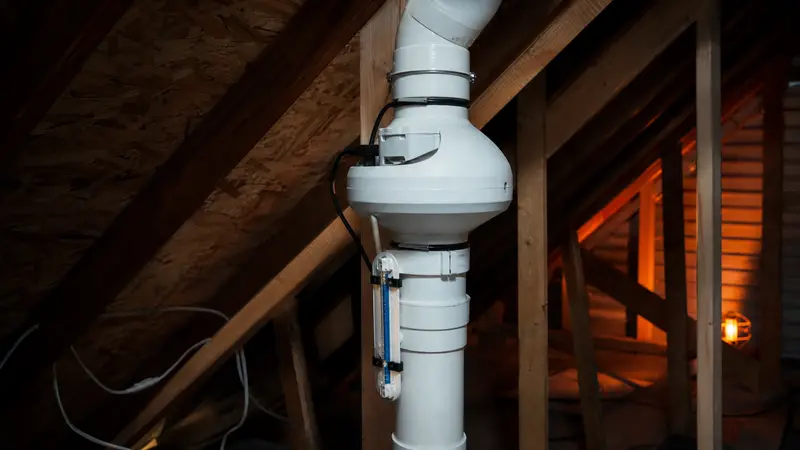
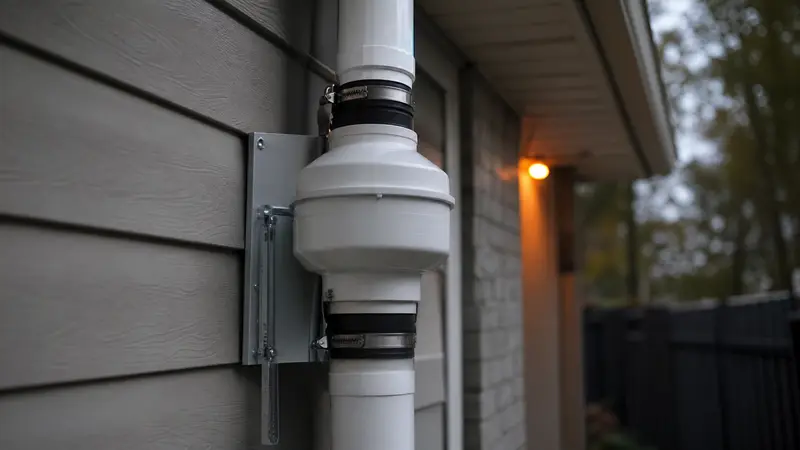
Radon fans are inline fans. They sit in the pipe, usually in the attic or on the outside of the house, and run all the time. A healthy fan gives off a soft, even hum. Near the exhaust you may also hear a gentle rush of air.
Inside the living space, a well-installed system should be close to silent. If you notice the fan from your bedroom or living room, something is passing the sound along.
Is a radon system noisy?
People often ask whether a new system will be loud. In most homes, no. The fan sits outside the living space, as required by recognized installation standards, and rubber couplings at each end of the fan help absorb vibration.
The parts you may hear are:
- A light hum near the fan itself.
- Airflow at the exhaust on a quiet night, especially near a window.
- A faint whoosh in interior pipe runs, mostly in a quiet basement.
These are normal. Grinding, rattling and loud buzzing are not. If you are planning a new system, talk with your installer about fan location and pipe routing. Those choices make the biggest difference in noise. Our team handles radon mitigation system installation in York with noise in mind.
Common causes of radon fan noise
Worn bearings
Bearings wear down after years of nonstop running. A worn bearing makes a grinding, squealing or rough rumbling sound that often gets louder over weeks. Bearings inside sealed radon fans are not a typical homeowner repair, so a fan with bad bearings usually needs replacing.
Poor mounting or loose couplings
If the fan is strapped tight against a rafter, stud or wall, its vibration travels through the framing and into the house. Loose or hardened rubber couplings can also let the fan shift and rattle. Reseating the fan, replacing the couplings, or adding proper support often solves this.
Ice, debris or nests
In winter, ice can build up at the exhaust or inside an exterior fan. Leaves, insects and bird nests can also get into an open discharge. Anything touching the fan blades makes a ticking or scraping noise. Clearing the blockage usually fixes it, but a fan that has run against ice for a while may have damage.
Water in the pipe
Condensation is normal in a radon pipe. If water collects in a low spot, the airflow can make a gurgling or bubbling sound. That points to a pipe slope problem, not a fan problem. Read more about water or gurgling in a radon pipe.
A fan sized wrong for the job
A fan that is too large for the soil under your slab can run loud and whistle as it pulls hard against tight soil. A fan that is too small may strain. A certified mitigator can check the suction reading and pick a better match.
Exhaust noise
Sometimes the fan is fine and the sound comes from air leaving the top of the pipe. This is more common when the discharge is close to a bedroom window or a deck.
Quick checks you can do
You can narrow down the cause before you call anyone:
- Find the source. Stand by the fan, then by interior pipe runs, then outside near the exhaust.
- Look at the manometer. If the reading is normal, the fan is still pulling suction. If it dropped or went level, the fan may be failing.
- Check for ice at the exhaust in cold weather.
- Touch the pipe near the fan (carefully). Strong shaking points to mounting or bearing issues.
- Listen for changes over time. A noise that grows louder each week is usually a bearing.
Do not open the fan housing or cut into the pipe. The fan is electrical, and the pipe carries radon-rich soil gas.
Fixes compared
| Noise | Likely cause | Usual fix |
|---|---|---|
| Grinding, squealing | Worn bearings | Replace fan |
| Rattling, buzzing in walls | Mounting, couplings | Reseat fan, new couplings, add support |
| Ticking, scraping | Ice or debris | Clear blockage, inspect fan |
| Gurgling | Water in a low spot | Re-slope pipe |
| Whistling, loud rush | Oversized fan or tight soil | Check suction, consider a better-matched fan |
Key takeaways
- A normal radon fan makes a soft hum and is hard to hear indoors.
- Grinding or squealing usually means worn bearings and a fan replacement.
- Rattling and buzzing through walls often comes from mounting, which is fixable.
- Gurgling is usually a pipe slope issue, not a fan issue.
- Check the manometer first. A normal reading means the fan is still working.
Frequently Asked Questions
Can I put insulation around my radon fan to quiet it?
Do not wrap the fan. Fans need airflow to stay cool, and covering one can cause overheating. Fix the mounting or vibration source instead.
Can I turn the fan off at night if it is loud?
No. Radon starts building back up soon after the fan stops. Fix the noise rather than shutting the system down.
Why did my fan get louder in winter?
Cold weather brings more condensation and the chance of ice at the exhaust. Both can change the sound. Check for ice first.
Get a noisy fan fixed
A loud fan is often an early warning that it is wearing out. We offer radon fan replacement in York and repair any brand of system. Call (717) 356-3035 any time for a same-day callback and a free written quote.